A Parlay
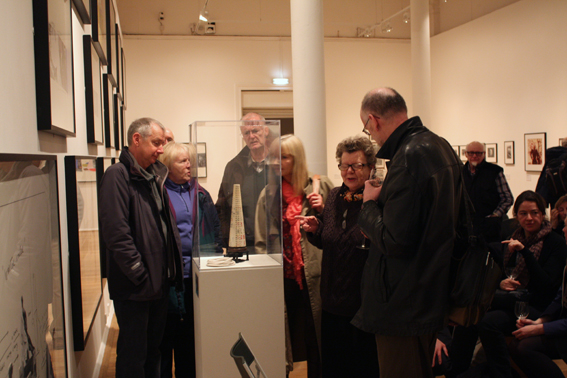
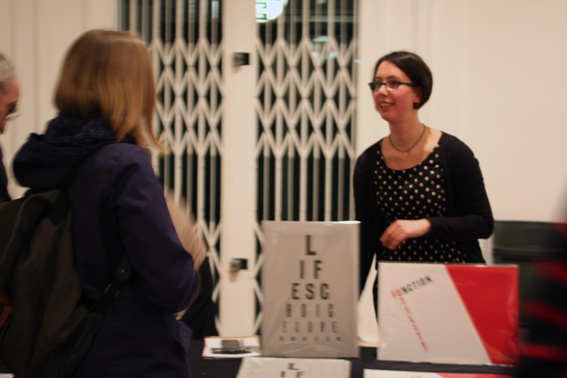 Last week I launched my new artists’ book ‘A Parlay’ at Leeds Art Gallery. The book is the outcome of a rather longer than expected project that I started just under a year ago. I’ve written about it already in a few previous posts but to re-cap, the content of the book came from a series of conversations I had with individuals at Leeds Art Gallery about the sculpture ‘Atom Body Was Light,’ 1964 by the artist Liliane Lijn. As well as the book I designed 2 new print works, printed by the The Print Project.
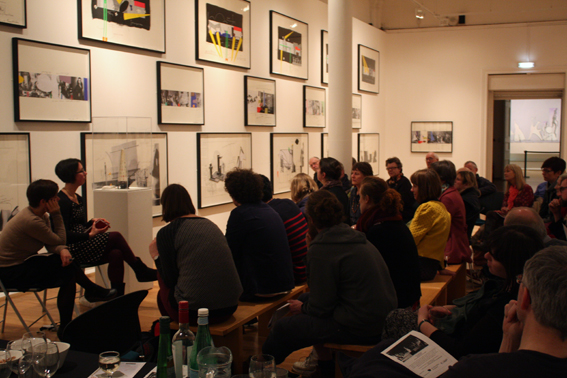
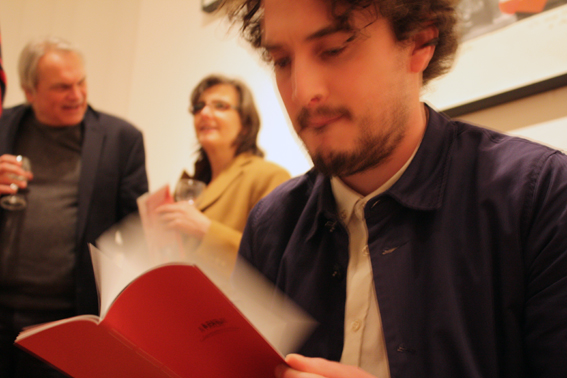 I must say thanks to everyone who came to the launch and supported the project. I really enjoyed the event. I also had a bit of a light bulb moment whilst I was talking to the audience who came along. A few days before I had heard an episode of ‘One to One’ on radio 4 in which a Jewish woman who was a feminist but accepted a lesser role for women in her religious life interviewed an older woman about her views one the subject. She was using this older woman, an experienced lawyer and a very successful professional, as a proxy for exploring her own views. Suddenly I realised that the artwork I chose – Lijn’s sculpture – has been a bit of a proxy for my own work. Of course the work I have made for this project has a visual affinity to Lijn’s work because it has been influenced by it. However, generally speaking, I think there is some similarity between my visual use of text and interest in arguably slightly obscure or not immediately apparent subject matter and this particular object that Lijn made in the 60s. I wonder, have I been thinking about value in general? Or have I really just been wondering all along about the value of what I do?!
5000 feet is the best
After the moan of my previous post, I want to tell you about another film that I saw yesterday that worked brilliantly in a gallery screening setting. ‘5,000 Feet is the Best‘ by Omer Fast is currently on show at the Imperial War Museum in London. The film is based upon interviews with an unmanned drone operator. Parts of it are extracts from an interview with the operator spoken in (or as if it’s in) his own voice. This is combined with images of the blurred out face of the operator (?) or aerial views of landscapes including Las Vegas (the glitzy hotel/casino part) and suburban residential areas. He speaks about his experiences including how clear one’s vision is of the area over which the drone is flying and about dealing with the fact of killing people, including the innocent. Interspersed with this ‘real’ interview there are staged scenes of a man in a hotel being interviewed. His interviewer sits there like a therapist, a journalist, or perhaps the artist filmmaker. The man being interviewed is acting as the ex-drone operator and also here is asked about his experiences but rather than answering the question directly he tells anecdotes.
One of the really clever things about Fast’s film is that this section loops but changes each time it does so. After the interviewee has told an anecdote something always interrupts the conversation (a phone ringing, or he needs to go for a cigarette). He leaves the room and when he returns the sequence begins again with the same questions. Each time the loop recurs (there are 4 loops if I remember rightly) the anecdote he tells is different. Sometimes it seems to relate more directly to the experience of war/being a drone operator and sometimes seems a bit more tangential. The anecdotes play with expectations of geography, race and the idea of being distanced from something or of playing a role.
I thought it was a great film in many ways and also really fantastic because the looping structure means you can walk into it from any point, start watching and it makes sense. Fast used the same strategy in the only other film by him that I have seen; ‘Continuity’ where a scenario involving a German family, whose son had been killed in Afganistan, is also repeated and altered effectively conveying the trauma experienced by the family in a series of weird and disturbing scenarios.
I should say that I don’t expect all films to loop and I do enjoy sitting through screenings of artists’ films, but I think it is about finding the exhibition format that is right for each work. This morning I watched a series of films at Whitechapel Gallery; ‘Artists Film International’ which included work of varying lengths but shown in an auditorium so you could happily sit through the whole screening of 75mins. The work here was really interesting too although I would have preferred to see Nasan Tur’s video ‘Berlin Says’ as a gallery installation. The video shows a man spraying slogans over each other onto a wall until the wall becomes obliterated by the words. To make the work easily watchable from start to finish, it included cross dissolves so you don’t get to watch it all in real time. I would have preferred it to be in real time in a gallery context where you could watch as much as you wanted and return to it repeatedly whilst looking around an exhibition. I guess it is possible that it does exist and has been shown in such a format too and that the version I watched has simply been edited for show reel type screenings.
Word. Sound. Power.
It’s a bit of a bug bear of mine when long films are exhibited in gallery settings; films designed to be watched from start to end. I find it especially annoying when the screening times are not stated but even when they are, long-from films in galleries are irritating. Yesterday I went to see the exhibition ‘Word. Sound. Power.’ at Tate Modern and several exhibited works were long. I didn’t take a note of the durations, but from memory there were 5 works ranging between 20 mins and 1 hour each.
For all I know these works might be really good, but I will probably never find out. Not only were they long, they were largely exhibited on monitors with just a couple of seats and headphones. I felt obliged to move on anyway by all the other visitors hanging around waiting to get their bums on the limited seating.
I ended up feeling unfulfilled, as if I hadn’t properly seen the exhibition. This is a real shame, and it’s a shame that I am writing about this situation rather than about the artwork. So, to talk briefly about the artwork – and this is a thought which is provisional, that I’m not totally resolved about – I felt that the exhibition was a strange mix of works that considered the more formal and physical/material aspects of language and works which alternatively focused on specific language forms (poetry, hip hop) as creative formats that can identify or unite particular communities of users and/or be used as a means of resistance.
In the first camp was work by Caroline Bergvall; ‘Voice’ and ‘Crop’ used word play to evoke the physical and audio qualities of speech. The longer films tended to fall into the latter camp with, for example, ‘Arise’ by Nikolaj Bendix Skyum Lasen focusing on young men in New Delhi who were finding meaning in their lives and potentially challenging their social and class position through getting involved in dance and rap. I can’t do this film justice because I watched hardly any of it but it seems there was a different formal language at play in this and the other longer documentary style films as compared to the more installation based works. Were it not for Lawrence Abu Hamdan’s ‘The Whole Truth’ and ‘Conflicted Phonemes’ the exhibition would have seemed strangely split down the middle. Abu Hamdan’s works were by far my favourite pieces in the exhibition.
‘Conflicted Phonemes’ used a large wall diagram to depict the scale and geography of migration both within and from Somalia since 1972 (when somali became an official language with a writing system). Alongside this were forms/A4 print outs detailing the cases of individual Somali asylum seekers in the UK who had their claims for asylum rejected due to accent analysis suggesting they did not come from south Somalia as claimed. The work showed how situations of war and famine have led to multiple regional influences on people’s speech. Abu Hamdan’s other work ‘The Whole Truth’ included a video of a line graph – its red line indicating various degrees of truth or lie – that was viewed in mirror, so you also watched yourself watching it. The soundtrack was made up of interviews with people including (according to the exhibition guide) software developers, anthropologists and entrepreneurs of the biometric industry talking about voice based lie detectors. I also noticed some audio taken from UK news programmes about such software being used by benefits agencies. Both works successfully explored how the audible and material aspects of voice have social and political ramifications.
What is art about?
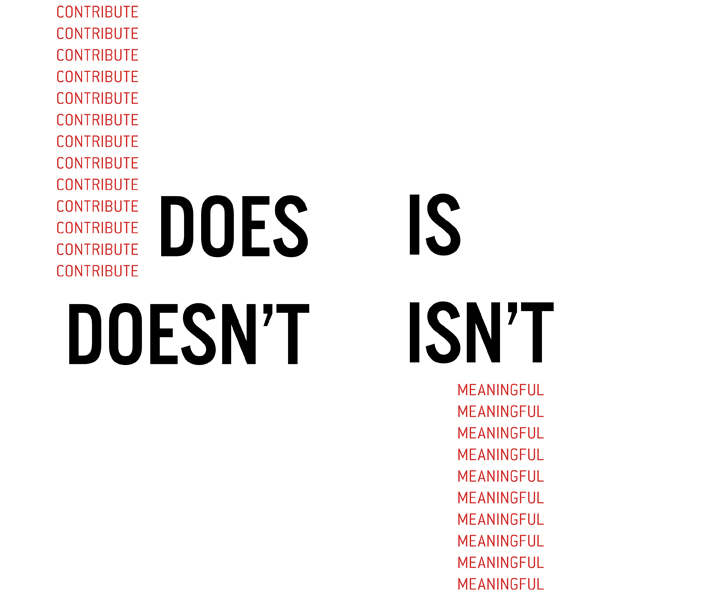
Another preview page from forthcoming artists’ book.
A few more thoughts and comments that haven’t made it directly into the final book. This time on the role of art.
First in response to the particular object (Lijn‘s sculpture):
It’s a questioning object, opening up other things to think about rather than an aesthetic inspirational object.
I don’t think you’re supposed to know what it is. We don’t know what things are in life.
First thoughts. It’s obscure. I am going to betray some prejudices…I think it’s too easy to be obscure, so I am sceptical.
It’s a question then of whether it works to create some impression in the observer that has some emotional impact. And I am not sure it does, in me at least.
…about the role of art in general:
I think it’s necessary. It’s not life or death necessary, but you can see people coming together.
We should have the attitude that art, science and literature should be part of everybody’s life. If not practicing you should at least have ability to look at it and enjoy regularly.
The first thing a work of art asks is “do you like me or do you not like me?” The second is: “why do you like me, why do you not?” It’s easy to ignore the second question but it’s hard to ignore the first.
If art’s only for one thing it’s for thinking. If it makes people think then it’s got to be good.
We can say all sorts of fancy stuff about art but it’s about having something good to look at or listen to, to smell or to chew.
Art definitely has a monetary value, overinflated. But there are various values in society, the making of art helps with mental issues. People make things and it releases something. Also there’s value in creating dialogue.
To me I would value the emotional aspect of it. What I don’t like is the art world of pretence and rather showy stuff that goes on because it’s exclusive and elitist and all that sort of thing.
People create works for a variety of reasons. One of them is purely personal. That they have a strong desire to create stuff, express something personal or about the outside world and knowledge they have about how things work. Sometimes they’re trying to make a statement. Sometimes it’s purely an element of wanting to create something really beautiful or stunning that sticks in people’s minds.
Art can be functional, it can be public benches, it can be wallpaper, utensils or furniture. Or it can be Henry Moore sculpture, something that’s completely not functional that’s interesting or nice to look at. Maybe not even nice to look at. It’s there and it’s making a statement.
I don’t necessarily make the distinction between art and design, I can see beauty in a lot of the things around us.
…and some thoughts about the accessibility of art, or lack of.
I’ve lived in Leeds for 10 years in Leeds, but only stepped into the gallery 2 or 3 times. I find that a bit sad. I am frequently in the area but there’s nothing to draw me in.
I will pass this place way more times than I come in, I am ashamed to say whole exhibitions come and go and don’t pop head in door.
We’re always wanting people to come in to art spaces who feel very uncomfortable and don’t feel they belong….The whole process so negative in terms of inviting people in who don’t understand white cube spaces.
Art has become far too esoteric….the rationale behind paintings you can’t understand unless you read up about it. It’s a ridiculous situation where you’ve got a painting but a lengthy explanation….I think art is about emotional impact and if you make it too intellectual you loose something.
I think it’s financially driven…I’d like to see art handled better in terms of corporations that just slap bits of sculpture in their entrance annoys me and councils who spend an inordinate amount of money on something that’s uninspiring. I think there could be better ways.