Floods
 When you’re thinking about making art it’s easy to find resonances for your projects everywhere. Now I am reading a new book Archipelago by Monique Roffey. I chose it only because I recently enjoyed another of her books The White Woman on The Green Bicycle. It has only just occurred to me that the title may have unconsciously appealed to me because I am staying in a country with lots of islands (although I am not near the coast).
The Archipelago referenced are however in the Caribean and Pacific. The novel starts in Trinidad and a father and his daughter journey to Los Roques and the Galapagos Islands.
Roffey wrote the book as a response real events, to actual floods and to climate change. She writes:
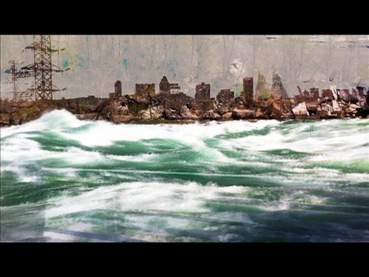 I hadn’t thought so much about how my Canadian footage might be read in terms of actual floods. I was thinking of the water as being metaphorical only, but perhaps shouldn’t forget real disasters and their impact.
Archipelago is also a book about escape, mental and physical. The travellers do not escape flooding because they find the same physical problems (earthquakes, flooding, broader climate change) in the other places that they visit. They do seem to be finding some escape from their feeling of trauma and inner turmoil which I guess may ultimately lead them to go home at the end of the novel. The wife/mother of the family is not on the journey with them because she has dealt with flooding and the loss of their son in another way, by retreating into herself, by ‘going to sleep,’ becoming mentally ill.
History of a landscape
Whist in Finland I decided to read Simon Armitage’s Walking Home in which he walks and then writes about the Pennine Way. I thought it would be interesting to read something about a landscape and a journey that is quite local to where I live (Yorkshire) whilst I am staying in a totally different place. Although I didn’t think about it at the time of choosing the book, I guess this relates to what I am hoping to explore in making the short video about imaginary journeys/places too.
Reading the book has made me realise how little I know about the landscape in the UK and about how to read its history and geography. The term ‘landscape’ perhaps conveys the idea of the environment as a kind of panorama to be taken in, rather than something that is lived in and experienced and that has a social and geological history to it too. Maybe I need to think a bit more about what I want to do with my images of landscape and why. Or, probably, I just need to start doing something and see what happens!
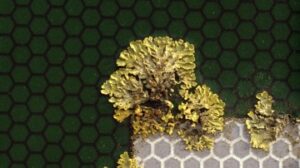 Also this week I watched a film about another UK journey. Robinson in Ruins by Patrick Keiller. The film is made up of a series of fixed-frame shots of different landscapes, urban and rural, around Oxfordshire (incidentally the area where I grew up although it’s another landscape I don’t know much about).
Formally this use of still-ish images and first person narration is a method I have used to make a a video before and has kind of been my default approach to starting to think about making video again. But it somehow doesn’t seem right to take long, lovely looking landscape shots of the area around where I am staying in Finland and to structure these into a video. After all what would I say about them? What would the story be? This feeling is, I think, to do with it being a landscape that I know nothing about but also that I have have no personal investment with. The video where I did use this method was of a bus stop very near to where I lived and I am currently thinking about making a couple of others centred on my own home and the views from it.
One thing that didn’t register when I bought a copy of Robinson in Ruins last year after seeing Keiller’s commission at Tate Britain, is that it was made as part of a wider research project on The future of landscape and the moving image. To quote the project website: since 2007 the project “has explored received ideas about mobility, belonging and displacement, and their relationship with landscape and images of landscape, in a context of economic and environmental crisis.” So I am sure there is more of interest for me to look at there.
Recent reads
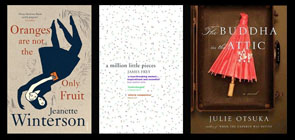 A Million Little Pieces – James Fey
This had been on my reading list for a while. I must have seen or heard a review of it somewhere. My awareness of the book was post the Oprah fall out, whereby the book had been sold as a memoir and Oprah championed it; then inaccuracies or fictional elements came to light and Oprah felt duped. So perhaps it was discussion around this idea of a fictional memoir that intrigued me. Plus I liked the title and cover of this book and Fey’s next one Bright Shiny Morning. So, enough incentive to give it a go.
But the book was really boring and I found it a slog to get to the end. The characters were trite and one dimensional the language uninspiring. It is one of the many books that follows the structure that, according to my mum – an ex-primary school teacher – is typical of how children start to write stories…This happened and then this happened and then this happened. Except that in this book nothing really happens. A man goes into drug rehabilitation, he doesn’t want to do the 12 step programme and wants to kick his habit his own way. He succeeds for his time in the unit and the book ends with his release. Along the way he also has a love interest, a family who love him but that he resents and a gangster friend/mentor.
So why am I bothering to write about this book? Well, I am interested in how it resonates with a contemporary culture of self-help typified by something like Oprah. It is a kind of superficial redemptive narrative where we follow a central narrator and his struggle for survival. The end note tells us he got through things – “James has never relapsed” – whilst most of the other characters fell off the wagon or died (although by the end when they are name checked I can’t remember who most of them are). At a stretch I might concede that the deadpan nature of the writing and lack of emotional depth to the book is meant to be some kind of comment on contemporary culture. A purposeful blankness. But it doesn’t work because the narrative arc is so tied up with the idea of redemption, where not everybody makes it but we do. I did find it interesting how, as a reader, I still invested in the typical narrative even with such meagre prompts. I wanted James to meet up with his girlfriend, I wanted him to get through the drug programme, I wanted him to resist a drink, I wanted him to somehow magically get out of his pending jail sentence. Even whilst these things irritated me and on a more critical level I didn’t want them to happen, there was still a kind of pull for this satisfying/dissatisfying story. I guess that’s the power of archetypal narratives and first person narrators!
The Buddha in the Attic – Julie Otsuka
This was really interesting to read after my previous moan about James Fey’s first person narrator. The whole book is written as “we” and “us”. It tells the story of Japanese women who traveled to America in the early 1900s as brides, to marry Japanese men who had preceded them. The book follows the settlers through their arrival, consummating their relationships, finding work, having children up until the second world war when they are sent to prisoner of war camps.
There is a good summary and review here, also including some of the prose:
http://www.guardian.co.uk/books/2012/apr/08/buddha-in-attic-julie-otsuka-review
The beauty of the book is how it depicts so many lives, mostly involving struggle, but with both happy and sad moments and with many different shapes, textures and attitudes. It gives a sense of individual lives being part of a bigger picture and of how people do their best to make a life in particular social circumstances. I don’t think that I’ve ever red a book written in this voice before.
Oranges are not the only fruit – Jeanette Winterson
Last year Why be happy when you could be normal? went on my reading list. Then I thought, perhaps I should read Oranges are not the only fruit first….just because it was written first I suppose and it seems like the later book is a revisiting or a return to the same themes.
Oranges are not the only fruit is a good example of a book that is fictional and, somewhat autobiographical. Unlike Oprah, we don’t in fact care whether it is true to a particular life or not. I will however be interested to see what the relationship of her new more overtly autobiographical book is to the novel. Will recount some of the same stores? Will it be written in a similar style?
I have found an interesting online article about Oranges are not the only fruit, the novel and the TV series. It suggests that the TV series was a realist text where the book was not. I have only seen fragments of the TV series, when I was too young to be interested in it but this is intriguing be a bit in relation to James Fey’s book. Like several books I have read recently Fey’s novel almost seems to be written with this more filmic or TV type narrative structure in mind.
An extract from the article:
“In this paper we argue that realist strategies facilitated the success of the television version of a lesbian coming-of-age novel. Cultural production aiming to challenge the prejudices of “commonsense” has everything to gain from working with popular cultural forms. The mechanisms of closure characteristic of popular narrative can facilitate the effective communication of radical ideas.”
See here for the whole thing: http://www.ejumpcut.org/archive/onlinessays/JC39folder/OrangesNotOnlyFruit.html