Open Music Archive
Last year I wrote a response to Open Music Archive’s dual exhibitions at Salford Museum & Art Gallery and Castlefield Gallery, Manchester. I entered a version of it into a writing competition…but didn’t get anywhere with that, so have decided to post it here.
A SIDE: Salford Museum and Art Gallery
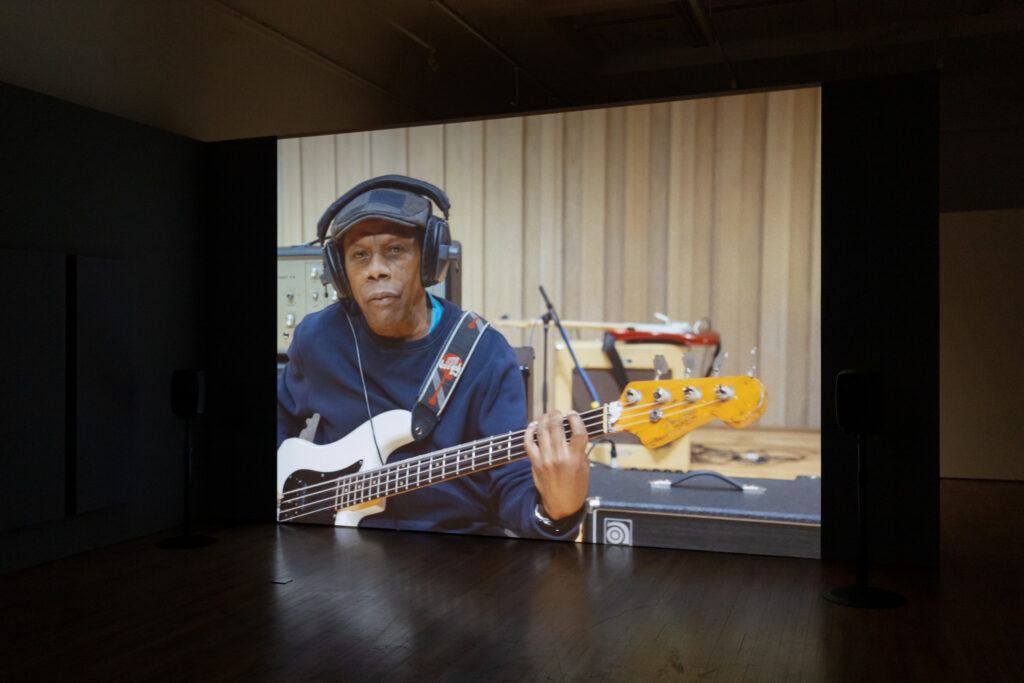
A woman and a man in a recording studio, wearing headphones and singing into stand-mounted microphones. They repeat a vocal phrase – “to be with you” – several times (as if on ‘loop’) before the sound transitions to a double-bass- bassline, casually plucked by an older gentleman. These performers are a few of the characters who populate ‘Everything I Have Is Yours’ (2019); a thirty-minute long moving image installation produced by artists Eileen Simpson and Ben White who collaborate as ‘Open Music Archive.’ Sixteen older musicians heeded the artists’ request to collaborate with them to compose and record a new piece of music, constructed from excerpts of pop records originally recorded between 1952 and 1962. The performers – dubbed ’the original teenagers’ – had their teen years during this decade, the first decade of the UK singles chart.
On screen today, far removed from their youth, some performers look like seasoned session-musicians whilst others (more tentative or eager) recall a teenaged attitude; as if their young-selves found themselves here, unexpectedly aged, uncertain of where the intervening years went. Performers play and sing individually, or in small groups, while the camera tracks a constant, anti-clockwise pan. This movement – revealing new musicians on each apparent rotation – mirrors footage of vinyl and shellac records, visually intercut with studio shots, and evokes a rueful sense of time’s relentless passage.
The film’s soundtrack has all the pull and fizz of pop music but is an extended deconstruction of pop’s component parts. An individual instrument (the double base or a plangent saxophone) is heard sometimes in isolation, like a single ‘track’ from a multi-track recording, before the composition builds. In other instances short, repetitive motifs evoke electronic music or provide ‘hooks’ that don’t develop as expected. Intercut close-ups of spinning records are stop-start. Repetitive. A visual analogue to the conglomerate sound; mimicking musical phrases performed ‘live’ in studio or accompanying extracts played direct from vinyl. The vinyl sound quality is recognisable; muffled and analogue – seemingly played from far away. ‘Everything I have is Yours’ is based upon content produced in an era before sampling or multi- track recording but its construction implies the mutations popular music has undergone since the inauguration of the charts.
The work’s power comes from its emotional resonance. It prompts reflection on time, technology and the enduring personal and cultural significance of music. But beyond such ruminations lies another crucial aspect of this artwork; pointedly foregrounded by text on ‘paused’ record labels reading: “copyright control” or “the rights of man.” As the name ‘Open Music Archive’ hints, Simpson and White have a conceptual and ethical interest in challenging (or creatively circumventing) copyright. The date 1962 – delimiting the artwork’s source material – is significant as a date when copyright rules were tightened. As the exhibition guide explains, there are two sets of U.K. copyright: composition copyright (granted to authors) lasts until 70 years after their death; copyright for recordings (made after 1962) lasts for 70 years from recording date. In choosing pre ’62 records the artists only need navigate the former. They do this by sampling or re-performing only extracts: notes, short phrases or breaths. Enough to convey the tone of the source whilst respecting creative copyright of still- living composers.
Rather than considering music as something to be individually owned, Open Music Archive’s work advances music as a collective resource. ‘Everything I Have Is Yours’ creates one example situation where music has brought people together in a vibrant, productive way. Contributors reclaim sounds that were part of the mental-landscapes of their youth; music that is arguably theirs as much as any authors – for it is the listener who puts music to use. Now we (as listeners or viewers in the gallery) get to join in the fun. A work about copyright could be dry and legalistic, causing an audience to switch off. This decidedly isn’t. The project educates about copyright, and invites consideration of its ethics whilst concurrently enacting the enjoyment that music-sharing can bring.
B SIDE: Castlefield Gallery
Alongside the newly commissioned ‘Everything I have is Yours’ – at Salford Museum and Art Gallery – Castlefield Gallery, nearby, held a sister exhibition of Open Music Archive’s earlier works. This shorter-run show provided an opportunity to gain a broader understanding of the artists’ approach.
Most overt in its challenge to copyright, ‘PLAYHEAD: A Parallel Anthology’ (2010- ongoing) was presented in a listening area where visitors could hear versions of tracks from the six-album compilation ‘Anthology of American Folk Music,’ compiled by Harry Smith in the early 1950s. The collection – which contributed to a mid- century folk revival – made diverse music, that had originally been issued from 1927- 32, available to a wide audience. Concurrently, however, it ‘fixed’ and copyrighted single versions of tracks previously shared and performed in multiple versions. Simpson and White’s parallel anthology reinvigorates the multiplicity. Tracks appear in the order of Smith’s collection but in alternative, uncopyrighted versions. An accompanying booklet indicates each track’s status, with blue typography for existing alternative versions and orange for remixes made for this project. Tracks still copyright-restricted are struck-through with black. At Castlefield Gallery the installation was slick, with graphic elements from the printed track-listing continuing in a colourful vinyl wall design. But it was the exhibition’s most didactic work, perhaps functioning better in its online version (see www.openmusicarchive.org/playhead) where content need not compete with other, more concise pieces.
‘Auditory Learning’ (2016) prefigures ‘Everything I Have Is Yours’ in form and method. Shown as a single-screen installation, it similarly depicts invited participants in a recording set-up, interspersed with shots of vinyl. Again it enacts a contemporary re-use of copyrighted material. This time, however, participants actually are teenagers and – rather than collaborating with them directly to write new music – Simpson and White asked contributors to vocalise freely, subsequently matching their experimental articulations to excerpts from 1962 records. Cautious “ahhs” and bravado-laden “huhs” meld with the archive sound. Dissonance resolves into harmony (and back again) evoking the tension between possibility and self-doubt involved in teenage-hood. The recording took place in an anechoic chamber – a room that absorbs all echoes. The novelty and unfamiliarity of this registers on contributors’ faces. Voice is both a metaphor for and an enabler of agency and the work communicates a sense of young people finding theirs. By combining individual, provisional utterances into a co-voiced work, it proposes power in numbers; the whole being more than the sum of its parts.
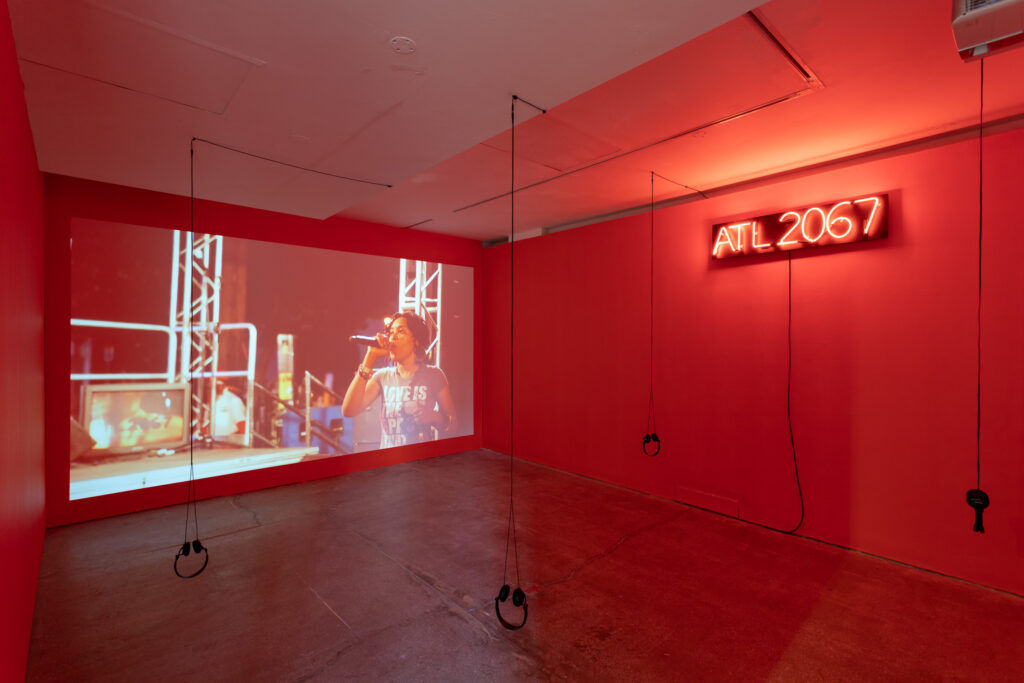
Further reiterating the power of collective voice were ‘ATL 2067’ (2013/2019) and ‘The Brilliant and the Dark’ (2010). For the former (made in Atlanta U.S.A.) the artists worked with local hip-hop producers to reuse and reimagine extracts of still- copyrighted 1920s folk and blues music; producing records to be played at a public open-mic event. The resulting film depicts open-mic participants freestyling about their imagined future city; optimistic conjectures of a cooperative future echoing the sharing ethos associated with both folk and hip-hop.
Where ‘ATL 2067’ is presented as a minimally-edited observational documentary, ‘The Brilliant and The Dark’ (commissioned by London’s Women’s Library) adopts the tightly choreographed format of a pop video. Women dressed in striking red robes – with head-pieces that recall Margaret Atwood’s ‘The Handmaid’s Tale’ or Louise Bourgeois’s ‘Femme Maison’ paintings – lip-sync to an absurdly catchy, choral pop piece. The composition, created with a 22-strong women’s choir ‘Gaggle,’ reprises a cantata originally performed by 1000 women in 1969 at the Royal Albert Hall. The original depicted the lives of women through the ages. The remake is a lament and a call to arms with vocals alternating between swooping, long-line harmonies (“we weep, for the dead” ) and snappy appeals (“fight, fight, fight”). The women here comply with the contemporary norms of pop- performance: they mime but with attitude. Popular culture is, at once, liberating and constraining. The music’s circular structure suggests that progress – towards equal rights – is recursive, not linear.
These projects demonstrate the artists’ adaptability in working with different communities and contexts. Their overarching concern with collaboration and co- authorship manifests differently in each. One final work – ‘Struggle in Jerash’ (2009) – stands apart because it does not take music, or copyright, as its instigator. It is a re-presentation of a 1957 Jordanian feature film, here narrated by contemporary Jordanian artists, curators, filmmakers and critics; invited to interpret the action. It does, then, share an intent to revitalise archive material. The film (purportedly Jordan’s first) was considered ‘lost’ until, following a 2008 residency in Amman, the artists gained access to the last VHS copy and re-circulated it in its current form. The soundtrack conversations can be compelling: discussion of changing norms of dress or behaviour, for example, raises broader questions about politics, religion and national identity. But it is a slow and meandering piece which struggles to hold attention.
Open Music Archive’s works that take on musical formats (whether pop video or experimental opus) have ‘oomph.’ They entertain and thus invite the viewer in. ‘Struggle in Jerash’ is a harder sell, but its inclusion has purpose. It intimates that the bigger project is not about music as such, or perhaps even about copyright per-se. Taken together these are works about agency and ownership. They posit the importance – and implement the act – of speaking-back to dominant cultural forms. The artists set up structures that allow multiple voices to speak (or sing). Their works are, in the first instance, mostly collaborations. They involve participants working together to create something new. We (gallery-goers or subsequent viewers) can’t access this experience directly; we observe its outputs and portrayal. In the couple of instances where resultant pieces fail to entirely hit the mark, this is less an issue of conception and more a failure of translation. For the main part, Open Music Archive – and collaborators – succeed in transforming complex, process-based projects into succinct, evocative gallery-based artworks.
‘Everything I Have Is Yours’ was shown at Salford Museum and Art Gallery from 4 July-3 November, 2019. Eileen Simpson and Ben White: Open Music Archive was at Castlefield Gallery, Manchester from 14 June-18 August, 2019.
Question Time – Simeon Barclay

One of my favourite exhibitions from 2018 was ‘Bus2Move’ by Simeon Barclay, at The Tetley Leeds. I thought it was a brilliant exhibition that used the unique spaces at the Tetley very effectively. So, I was happy to have the chance to interview Simeon recently for a-n.
This is one of the few times I’ve done artist interviews and thanks go to Simeon for being a really accommodating interviewee. I hope I’ve done his words and his work justice in my write up which you can read on the a-n website.
Best Exhibitions of 2018
I was pleased recently to be asked by a-n to select my top exhibitions from 2018. Read my selections here: Best exhibitions of 2018
In The Crosswind
One of my favourite films at Leeds International Film Festival this year (and an audience favourite overall too) was ‘In The Crosswind’ (or ‘Risttuules’ in Estonian). The film is like an epic history painting, composed – apart from a brief opening scene – entirely of a series of tableaux vivants. Characters stand motionless whilst the camera weaves between them; their poses and expressions fleshing out the story of each scene. The film is set in 1941 when Stalin’s regime separated Baltic families, with men sent to prision and women and children to forced labour camps. A narrative voiceover reads letters written by a woman, Erna, to her husband when she and her daughter are deported from their home in Estonia to Siberia. On watching the film I presumed the letters were real, archive documents written and kept by the women as a kind of diaristic record and a gesture of communicating with her husband even though they were probably never sent. Research since has indicated that around 60% of the content came from letters written by a relative of the director. The remaining 40% of content was sourced from archives. Thus the woman Erna is based on a real woman but is also in part a composite character, combining details of several people’s stories.
The film is harrowing, its power comes from the sadness of the personal story it relates (one story representing the fate of thousands at this time). It also comes from the film’s artistic language and the interplay between the verbal voiceover and the visual scenes. The films’ posed scenes and its bleak landscape, all filmed in black and white, are beautiful. Scenes range from tableaux of small groups to those featuring hundreds of protagonists. I particularly recall an early scene at the railway station, where Estonian families are being forced onto a train, crammed in with their belongings. Numerous faces and poses fill this epic image. Later in a Siberian forest, swathed in snow, the vertical black lines of the trees and contrasting white provide a harsh but weirdly intimate location for a sad personal event. On the soundtrack, the letters are restrained and incredibly sad as Erna attempts to put a positive slant on her situation, yet the images we see tell us otherwise. Interaction between voice and image is well paced. Camera movement generally alternates with verbal voiceover, so the letters accompany still scenes and then the camera explores the scene further to reveal more details or nuances. Added to this is a subtle but evocative musical soundtrack of low drones, orchestral swoops, choral singing and character sounds such as whispers.
The film is directed by Martti Helde. I wanted to find out more about how the film was made and what he’s done before. It turns out he’s a first time director which I think is pretty amazing for a film of this ambition. I find it hard to imagine how the more complex scenes in the film were produced and I guess that this type of film may only have become possible with recent equipment and computer software. I found a ‘making of’ video which gives some details of how original footage was combined with 3d mapping and post-production digital editing.
I’ll be really interested to see what Martti Helde does next. ‘In The Crosswind’ has a very specific visual language which is appropriate to the story it tells. Helde explains that the choice to use stills came from a very specific quote he came across in one of the letters, which read: ‘I feel like time has stopped here in Siberia. That my body is in Siberia, but my soul is still in my homeland.’ For me the format works because as a viewer you identify with the main protagonist whose voice is also on the soundtrack, yet the sheer number of others in the shots conveys the mass of people who suffered the same fate and their static poses suggest the lack of agency or control they had over their own lives at this time. It evokes how the individual always lives their lives against the backdrop of a history largely outwith their control. Some of the film’s power may be that I have seen nothing quite like this before. One precedent is Chris Marker’s film La jetée (1962); another film which I love but which is not as complex or epic as this. I hope Helde will go on to push the language of film in other interesting ways in subsequent projects.
More info: The film is described in more detail by another positive reviewer, Nikola Grozdanovic, here and here by Jacqueline Valencia who interviews Helde and asks him some interesting questions about the film’s score. Martin Kudláč asks Helde about the visual language of the film and particularly the preparation process with the Director of Photography Erik Põllumaa where they looked at references from visual art including walk through sculpture gardens.