#Typemotion
‘Type Motion’ at FACT Liverpool from 13 Nov 2014-8 Feb 2015 is a strange beast, a kind of survey show of animated type, ranging from concrete poetry to contemporary pop videos.
On entering the first exhibition gallery, where 24 works are shown across 7 screens, I felt as if I’d entered the futuristic city of Ridley Scott’s ‘Bladerunner.’ Mirrored walls add to the visual and auditory cacophony of 7 simultaneous works. This curation is intentional, I realised, as I read the gallery hand out which describes typemotion films that create ‘virtual architecture reminiscent’ of ‘cities flooded with adverts.’ The trouble is, a lot of selected works – to my mind at least – don’t invite or benefit from this visual overload. Films such as ‘Text/Image’ by Josef Linschinger and ‘ICI’ by Stephen Groß are subtle and slow. The works are installed without attention to their individual nuances and the set up made it hard to watch them without distraction.
An attempt to deal with this was made in the second, upstairs gallery where you could explore an archive of over two hundred films on an ‘interaction station’. This station – developed by xm:lab – was quite a technical wonder with films organised chronologically in different categories, including ‘Music Video’, ‘TV avant-garde,’ and ‘Fluxus,’ all operated by touch screen. It was a great resource with information provided about each film. However there was only one station controlling projections on two screens. I overheard a staff member showing a group around explaining that at any one time, there could be up to 10 people adding films to the two playlists. She suggested that this installation plus another interactive piece (where you could fly across a virtual cityscape to discover films) were aimed at a younger, teenage audience. I couldn’t help thinking that as a teenager I’d have been annoyed to select films only to have them cancelled or skipped by another visitor, even if they were my friend or classmate – just as I do now. Thankfully I visited on a quiet day when snow was keeping many people away from the gallery. So I had the luxury of spending a couple of hours viewing films from the archive, with only the occasional interruption. The joy of this format is that you can navigate to what interests you; so I spent my time watching Dada, concrete poetry and experimental artists’ video with a few forays into film titles and advertisements. I watched some great pieces including ‘Word Movie’ by Paul Sharits and various works by Len Lye I’d seen some of before as well as many new discoveries such as work by Paul Glabicki and FluXus Heidelberg.
The collection of work is remarkable and a huge amount of research has evidently gone into putting this project together. It’s a shame the archive is not accessible outside the gallery – although apparently a publication/catalogue is forthcoming. For now, at least, I have a long list of names of artists and designers to research further in the relative quiet of my home.
Love letters – Measures of Distance
Last week I had a conversation with a friend about the programming of an arts organisation whose work I am generally interested in – I find it enjoyable but, as I said to her, “I do not love it.” This prompted me to ask myself the question: “what works of art do I love?” and I started to make a list. If I manage to keep it up, I am planning to write a series of blog posts about the works over the coming weeks.
To start off with, I thought I’d post a link to piece of writing I wrote a few years ago about the artwork ‘Measures of Distance’by Mona Hatoum. It’s a little bit of an unresolved piece, slightly awkward, but I still like parts of it. I think of it as a kind of love letter to Hatoum’s work of art. It was written for the publication RITE, 2010, published by Open Dialogues and New Work Network.The design/layout is by Wood McGrath.
Most of the works I can think of that I love are artists’ films or videos. This could show that I’m working in the right way myself, making videos at the moment. Or it could just be that I have video on the brain!
Review: Anand Patwardhan – A Cinema of Songs and People
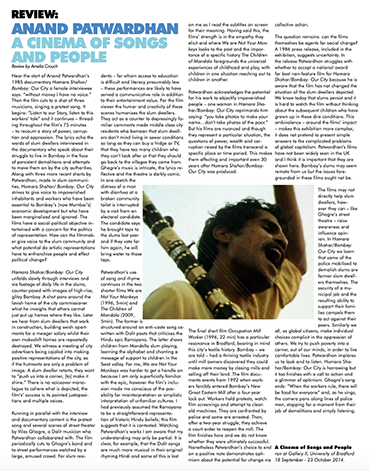
This review was first published in The Mirrored Hammer – a newspaper of Music, Art, Culture and Critique for Leeds and Bradford in November 2014. The exhibition was at Gallery II from 18 Sep-23 Oct 2014
Near the start of Anand Patwardhan’s 1985 documentary “Hamara Shahar/Bombay: Our City ” a female interviewee says: “without money I have no voice.” Then the film cuts to a shot of three musicians, singing a protest song. It begins: “Listen to our Story, listen to this workers’ tale” and it continues – threading throughout the film’s 75 minutes – to recount a story of power, corruption and oppression. The lyrics echo the words of slum dwellers interviewed in the documentary who speak about their struggle to live in Bombay in the face of persistent demolitions and attempts to move them on by the city authorities. Along with 3 more recent shorts by Patwardhan, made in slum communities, “Hamara Shahar/ Bombay: Our City” strives to give voice to impoverished inhabitants and workers who have been essential to Bombay’s (now Mumbai’s) economic development but who have been marginalized and ignored. The films have a social-political objective intertwined with a concern for the politics of representation. How can the filmmaker give voice to the slum community and what potential do artistic representations have to enfranchise people and affect political change?
“Hamara Shahar/Bombay: Our City” unfolds slowly through interviews and via footage of daily life in the slums, counter-posed with images of high-rise, glitzy Bombay. A shot pans around the lavish home of the city commissioner whist he inveighs that others cannot just put up homes where they like. Later we hear from slum dwellers that work in construction, building swish apartments for a meager salary whilst their own makeshift homes are repeatedly destroyed. We witness a meeting of city advertisers being cajoled into making positive representations of the city, as if the hutments are only a problem of image. A slum dweller retorts, they want to “push us into a corner, [to] make it shine.” There is no voiceover monologue to cohere what is depicted, the films’ success is its pointed juxtapositions and multiple voices.
Running in parallel with the interview and documentary content is the protest song and several scenes of street theater by Vilas Ghogre, a Dalit musician who Patwardhan collaborated with. The film periodically cuts to Ghogre’s band and to street performances watched by a large, amused crowd. For slum residents – for whom access to education is difficult and literacy presumably low – these performances are likely to have served a communicative role in addition to their entertainment value. For the film viewer the humor and creativity of these scenes humanises the slum dwellers. They act as a counter to depressingly familiar comments made middle class city residents who bemoan that slum dwellers don’t mind living in sewer conditions so long as they can buy a fridge or TV, that they have too many children who they can’t look after or that they should go back to the villages they came from. Ghogre’s music is intricate, the lyrics reflective and the theatre is darkly comic. In one sketch the distress of a man with diarrhea at a broken community toilet is interrupted by a visit from an electoral candidate. The candidate says he brought taps to the slums last year and if they vote for him again, he will bring water to those taps.
Patwardhan’s use of song and rhyme continues in the two shorter films “We are Not Your Monkeys” (1996, 5min) and “The Children of Mandala” (2009, 5min). The former is structured around an anti-caste song co-written with Dalit poets that criticises the Hindu epic Ramayana. The latter shows children from Mandella slum playing, learning the alphabet and chanting a message of support to children in the Swat valley. For me “We are Not Your Monkeys” was harder to get a handle on because I am only superficially familiar with the epic, however the film’s inclusion made me conscious of the possibility for misinterpretation or simplistic interpretation of unfamiliar cultures. I had previously assumed the Ramayana to be a straightforward representation of historic Hindu beliefs; this film suggests that it is contested. Watching Patwardhan’s works I am aware that my understanding may only be partial. It is clear, for example, that the Dalit songs are much more musical in their original rhyming Hindi and some of this is lost on me as I read the subtitles on screen for their meaning. Having said this, the films’ strength is in the empathy they elicit and where “We are Not Your Monkeys” looks to the past and the importance of a specific history “The Children of Mandala” foregrounds the universal experiences of childhood and play, with children in one situation reaching out to children in another.
Patwardhan acknowledges the potential for his work to objectify impoverished people – one woman in “Hamara Shahar/Bombay: Our City” reprimands him saying: “you take photos to make your name…don’t take photos of the poor.” But his films are nuanced and though they represent a particular situation the questions of power, wealth and corruption raised by the films transcend a specific place or time period. This makes them affecting and important even 30 years after “Hamara Shahar/Bombay: Our City” was produced.
The final short film “Occupation Mill Worker” (1996, 22 min) has a particular resonance in Bradford, bearing in mind this city’s textile history. Bombay – we are told – had a thriving textile industry until mill owners discovered they could make more money by closing mills and selling off their land. The film documents events from 1992 when workers forcibly entered Bombay’s New Great Eastern Mill after a four-year lock out. Workers hold protests, watch film screenings and attempt to clean old machines. They are confronted by police and some are arrested, then after a two year struggle they achieve a court order to reopen the mill. The film finishes here and we do not know whether they were ultimately successful. Nonetheless Patwardhan’s choice to end on a positive note demonstrates optimism about the potential for change via collective action.
The question remains: can the films themselves be agents for social change? A 1986 press release, included in the exhibition, suggests uncertainty. In the release Patwardhan struggles with whether to accept a national award for best non-feature film for “Hamara Shahar/Bombay: Our City” because he is aware that the film has not changed the situation of the slum dwellers depicted. We know today that slums persist and it is hard to watch the film without thinking about the subsequent children who have grown up in these dire conditions. This ambivalence – around the films’ impact – makes this exhibition more complex; it does not pretend to present simple answers to the complicated problems of global capitalism. Patwardhan’s films have not been widely seen in the UK and I think it is important that they are shown here. Bombay’s slums may seem remote from us but the issues foregrounded in these films ought not be.
The films may not directly help slum dwellers however they can – like Ghogre’s street theatre – raise awareness and influence opinion. In “Hamara Shahar/Bombay: Our City” we learn that some of the police mobilsed to demolish slums are former slum dwellers themselves. The security of a municipal job and the resulting ability to support their families compels them to act against their peers. Similarly we all, as global citizens, make individual choices complicit in the oppression of others. We try to push poverty into a corner, out of our minds, in order to live comfortable lives. Patwardhan implores us to look and to listen. “Hamara Shahar/Bombay: Our City” is harrowing but it too finishes with a call to action and a glimmer of optimism. Ghogre’s song ends: “When the workers rule, there will be food for everyone” and, as he sings, the camera pans along lines of police men, stopping for a moment from their job of demolitions and simply listening.
Reflecting on RECON
A few weeks ago it was RECON, a festival of experimental art and music in Leeds and Bradford. I attended some of the festival events and since then have been mulling over the question of audience. Specifically how or whether an artist or musician thinks about their relationship to and interaction with an audience.
I know this isn’t a novel question and it’s certainly not particular to this festival, yet my experiences of RECON raised it foremost in my mind. Perhaps this was because Yvonne Carmichael’s silent gig with That Fucking Tank was explicitly concerned with how audiences usually behave at gigs. Or perhaps it was the starkly different approaches shown by David Thomas Broughton and James Yorkston at their gig at the Howard Assembly Rooms. Whatever the reason, here are my reflections.
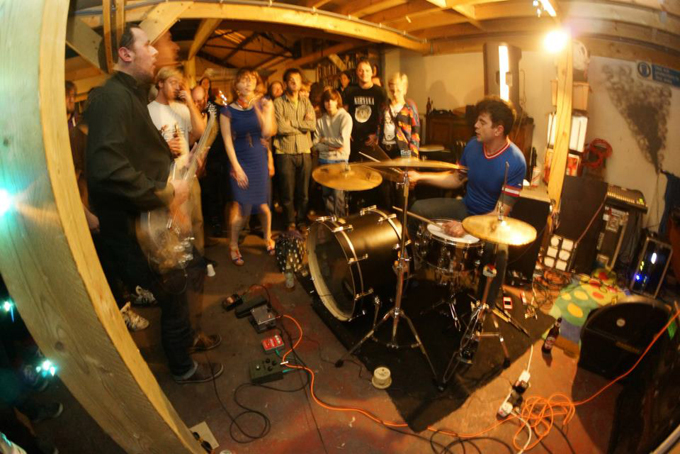
Yvonne Carmichael & TFT Silent Gig
The set up for the silent gig at Bradford’s Delius Centre (there was another instance of the gig in Leeds that I didn’t go to) had the two members of That Fucking Tank playing their instruments in the centre of the room, surrounded by us, the audience. Interspersed with the audience were some dancers – trained and untrained – who had been to a series of workshops to prepare for this event. Oh, and we were all wearing headphones. The music was unamplified (a la silent disco) so you could tune-out and just watch if you wanted to. The dancing didn’t begin immediately and there was an initial frisson of anticipation about who was a plant and who a regular audience member. Soon though it became quite clear who was who. The dancers formed a kind of circle around the band and, although they flowed in and out of more tightly choreographed moves, they were quite distinct from the head-nodding, drink-holding attendees. I found myself ever-so-slightly taking on the moves of the dancers. My muscles would twitch in line with their actions and I considered throwing caution to the wind and breaking into the circle, but I didn’t. One woman did. Good for her. The rest of us nodded away but with an added awareness of each other. What I liked most about the set up was how enjoyable it was to watch, not just the band and the dancers but also the other audience members. In Bradford the event had a very convivial atmosphere. The audience size was limited by the number of sets of headphones available (25 I believe) and I think that most people attending probably knew the performers or knew someone who did. Audience was explicitly thought about and the event was designed with an audience, although a limited one, in mind.
Frozen Music
The intimacy of this event contrasted with the very public ‘Frozen Music’ by Amorphous Orchestra which happened two nights running outside Leeds Art Gallery. I attended on the first evening when a moderate crowd gathered on Victoria Gardens to watch. I wasn’t sure what to expect, the event was described as a live music and projection event using “the realtime scanning of performer’s brains to melt and morph the architecture of Leeds Art Gallery.” I wondered, how long would it be? Would it be linear, designed to be watched from beginning to end or a looping drop in-drop out affair? There wasn’t the usual framing provided by being in a particular type of venue or by being clearly either a) an art installation or b) improvised music. This was some kind of melding of the two. In the event it seemed to be a linear piece, with the music and projections both building over a period of time. So I was compelled to watch it in its entirety and I found it an enjoyable visual and sonic experience. Yet I remained a bit confused about its structure and about exactly what its purpose was. One thing I noticed was that very few passers by stopped to watch. I expect that to some extent this was due to the time of day, when commuters just wanted to get home. However I also wonder if it was partially because it wasn’t very clear how, as an audience member, you might interact with the work.
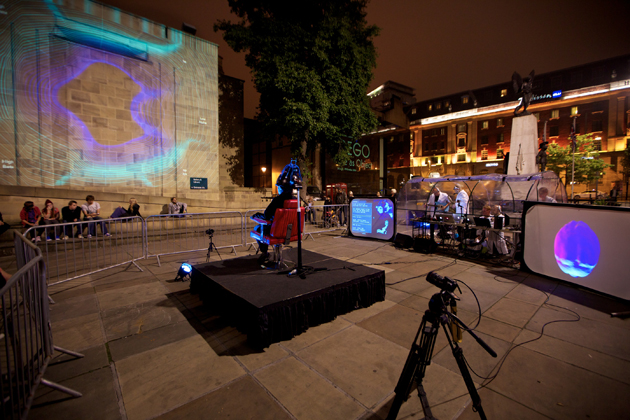
I’ll give a brief description. Firstly, you could see a group of men in white coats in a mini poly-tunnel with lots of electronic equipment, laptops and some musical instruments. They were playing some music, combining electronics and live elements. Placed nearby was a kind of dentist/barbers chair (rather Sweeney Todd) in which sat a woman, also in a white coat, with a contraption on her head. She was facing a large projection on the external wall of the art gallery. If you read the festival literature – as per the description above – then you would know that there was a relationship between the music, the woman’s cerebral response to it and the projections. Her brain waves would be used to manipulate the projected images. Was it a performance or was it a science experiment? For me it fell between the two. If it was a science experiment then I wanted more explanation of how the projections related to the subject’s brain activity. If it was a performance, then I wanted more consideration to be given to what the visuals conveyed. I liked the white coats and the look of ‘science’, plus the theatrical chair but was irked that it was always a woman in the chair, whilst men twiddled nobs. At times the projections looked sort of brain shaped, sometimes they looked like graphical representations of electrical activity but at other points there were recognisable images. I wondered, was there a logic and mechanism to this? An occasional electronic voice said things like: “entering phase 2, phase 2 – scanning the [insert a brain area]” which provided some explanation and guidance to the structure of the work, but it was a bit obtuse. The work could have benefited from an introduction or people on hand who were obvious guides. I felt that – in working out how to combine all the visual, acoustic and technical elements – an overall consideration of the audience’s experience was lost. Having said this, the premise of the piece is interesting and I hope there’s potential for its collaboration to further develop.
James Yorkston & David Thomas Broughton
The last event I want to talk about was a gig at the Howard Assembly Rooms, within Leeds’ Grand Theatre. My experience of this began with a similar framing anxiety. I was out for dinner and time was getting tight. At a gig doors usually open way before the music begins, but at the theatre or at a classical concert you’re expected to be there before the stated ticket time. What would the etiquette be here? Luckily our food arrived promptly and we got to the venue 5 minutes before start time. The next dilemma was where to sit. At the back of the room there was raked seating but at the front, cabaret style circular tables with surrounding chairs. Like most people we automatically headed towards the safe distance of the rows. Then in a moment of abandon I said: “let’s sit at the front” and we did. Right at the front. It turned out to be the best viewing spot for the first act David Thomas Broughton but not a great one for the second act James Yorkston, when I wished I could sneak away.
I lack the musical reference points and adequate vocabulary to describe music very well. As with the acts I’ve mentioned earlier in this post you’ll have to search online if you want to hear what these musicians sound like. However I think it’s safe to say that James Yorkston is fairly straight-down-the-middle contemporary folk with a somewhat pop sensibility. He is very competent but I found the songs rather dull. His saving grace was his audience patter. Between songs he told endearing stories. He may well tell the same stories every night but it worked.
Yorkston’s approach was a complete contrast to David Thomas Broughton who had no chit-chat verbal engagement with the audience but whose set was much more of a performance, interacting with the audience and the situation of the particular venue. Broughton’s music is also ‘folk’ but more ramshackle and more interesting. He records and loops sections of his voice, guitar and other noise makers such as an attack alarm and – in this instance – the creaky floorboards of the stage. He had 3 backing singers/performers who contributed not only gorgeous vocals but also interesting visual diversions such as tangling themselves up in microphone wires and wandering off in to the audience. Rather like Yvonne Carmichael’s dancers, I got the impression that they were improvising within certain set rules. Though I am sure that Broughton has tropes that he repeats at different gigs, it felt like a one off and this made it exciting. His attitude to the audience came across as conflictingly a little diffident and a little belligerent (compared to Yorkston’s friendly stories at least). He sang out above our heads and then walked amongst us, he stood on the front of the stage playing a buzzer on his belly (this was very funny) with a scowl and essentially imbued the gig with a whole lot of character.
I was reminded of a section in the film about Nick Cave “20,000 Days On Earth” where Cave talks about being a performer at small gigs where he picks out individuals from the crowd by making direct eye contact with them. The film shows footage of this; a packed, standing audience cram against the stage and are obviously loving the intensity of the encounter even though, to me, it seemed quite aggressive. This is juxtaposed with footage from a much larger concert at the Sidney Opera House. Here the audience is seated and Cave is on stage behind a piano and accompanied by a choir in addition to the band. It is a completely different dynamic yet he finds a way to relate to the audience in each. In the end I guess there’s no right or wrong way for performers to interact with their audience, but it is important for them to think about what works in a particular, given context. RECON’s experimental remit and boundary-crossing between art and music provides and extra challenge for audiences who may be experiencing unfamiliar work in an unusual setting. Hence it raises a challenge also to the performers, to consider and to orchestrate the type of encounter that they want.