#Typemotion
‘Type Motion’ at FACT Liverpool from 13 Nov 2014-8 Feb 2015 is a strange beast, a kind of survey show of animated type, ranging from concrete poetry to contemporary pop videos.
On entering the first exhibition gallery, where 24 works are shown across 7 screens, I felt as if I’d entered the futuristic city of Ridley Scott’s ‘Bladerunner.’ Mirrored walls add to the visual and auditory cacophony of 7 simultaneous works. This curation is intentional, I realised, as I read the gallery hand out which describes typemotion films that create ‘virtual architecture reminiscent’ of ‘cities flooded with adverts.’ The trouble is, a lot of selected works – to my mind at least – don’t invite or benefit from this visual overload. Films such as ‘Text/Image’ by Josef Linschinger and ‘ICI’ by Stephen Groß are subtle and slow. The works are installed without attention to their individual nuances and the set up made it hard to watch them without distraction.
An attempt to deal with this was made in the second, upstairs gallery where you could explore an archive of over two hundred films on an ‘interaction station’. This station – developed by xm:lab – was quite a technical wonder with films organised chronologically in different categories, including ‘Music Video’, ‘TV avant-garde,’ and ‘Fluxus,’ all operated by touch screen. It was a great resource with information provided about each film. However there was only one station controlling projections on two screens. I overheard a staff member showing a group around explaining that at any one time, there could be up to 10 people adding films to the two playlists. She suggested that this installation plus another interactive piece (where you could fly across a virtual cityscape to discover films) were aimed at a younger, teenage audience. I couldn’t help thinking that as a teenager I’d have been annoyed to select films only to have them cancelled or skipped by another visitor, even if they were my friend or classmate – just as I do now. Thankfully I visited on a quiet day when snow was keeping many people away from the gallery. So I had the luxury of spending a couple of hours viewing films from the archive, with only the occasional interruption. The joy of this format is that you can navigate to what interests you; so I spent my time watching Dada, concrete poetry and experimental artists’ video with a few forays into film titles and advertisements. I watched some great pieces including ‘Word Movie’ by Paul Sharits and various works by Len Lye I’d seen some of before as well as many new discoveries such as work by Paul Glabicki and FluXus Heidelberg.
The collection of work is remarkable and a huge amount of research has evidently gone into putting this project together. It’s a shame the archive is not accessible outside the gallery – although apparently a publication/catalogue is forthcoming. For now, at least, I have a long list of names of artists and designers to research further in the relative quiet of my home.
Love letters – Measures of Distance
Last week I had a conversation with a friend about the programming of an arts organisation whose work I am generally interested in – I find it enjoyable but, as I said to her, “I do not love it.” This prompted me to ask myself the question: “what works of art do I love?” and I started to make a list. If I manage to keep it up, I am planning to write a series of blog posts about the works over the coming weeks.
To start off with, I thought I’d post a link to piece of writing I wrote a few years ago about the artwork ‘Measures of Distance’by Mona Hatoum. It’s a little bit of an unresolved piece, slightly awkward, but I still like parts of it. I think of it as a kind of love letter to Hatoum’s work of art. It was written for the publication RITE, 2010, published by Open Dialogues and New Work Network.The design/layout is by Wood McGrath.
Most of the works I can think of that I love are artists’ films or videos. This could show that I’m working in the right way myself, making videos at the moment. Or it could just be that I have video on the brain!
Review: Anand Patwardhan – A Cinema of Songs and People
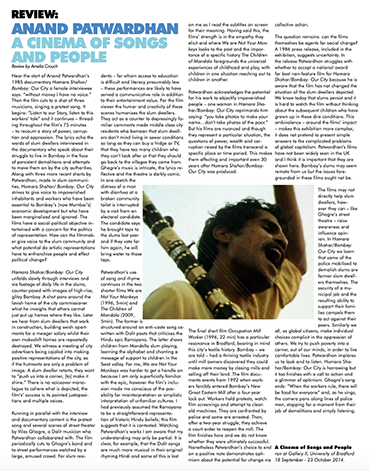
This review was first published in The Mirrored Hammer – a newspaper of Music, Art, Culture and Critique for Leeds and Bradford in November 2014. The exhibition was at Gallery II from 18 Sep-23 Oct 2014
Near the start of Anand Patwardhan’s 1985 documentary “Hamara Shahar/Bombay: Our City ” a female interviewee says: “without money I have no voice.” Then the film cuts to a shot of three musicians, singing a protest song. It begins: “Listen to our Story, listen to this workers’ tale” and it continues – threading throughout the film’s 75 minutes – to recount a story of power, corruption and oppression. The lyrics echo the words of slum dwellers interviewed in the documentary who speak about their struggle to live in Bombay in the face of persistent demolitions and attempts to move them on by the city authorities. Along with 3 more recent shorts by Patwardhan, made in slum communities, “Hamara Shahar/ Bombay: Our City” strives to give voice to impoverished inhabitants and workers who have been essential to Bombay’s (now Mumbai’s) economic development but who have been marginalized and ignored. The films have a social-political objective intertwined with a concern for the politics of representation. How can the filmmaker give voice to the slum community and what potential do artistic representations have to enfranchise people and affect political change?
“Hamara Shahar/Bombay: Our City” unfolds slowly through interviews and via footage of daily life in the slums, counter-posed with images of high-rise, glitzy Bombay. A shot pans around the lavish home of the city commissioner whist he inveighs that others cannot just put up homes where they like. Later we hear from slum dwellers that work in construction, building swish apartments for a meager salary whilst their own makeshift homes are repeatedly destroyed. We witness a meeting of city advertisers being cajoled into making positive representations of the city, as if the hutments are only a problem of image. A slum dweller retorts, they want to “push us into a corner, [to] make it shine.” There is no voiceover monologue to cohere what is depicted, the films’ success is its pointed juxtapositions and multiple voices.
Running in parallel with the interview and documentary content is the protest song and several scenes of street theater by Vilas Ghogre, a Dalit musician who Patwardhan collaborated with. The film periodically cuts to Ghogre’s band and to street performances watched by a large, amused crowd. For slum residents – for whom access to education is difficult and literacy presumably low – these performances are likely to have served a communicative role in addition to their entertainment value. For the film viewer the humor and creativity of these scenes humanises the slum dwellers. They act as a counter to depressingly familiar comments made middle class city residents who bemoan that slum dwellers don’t mind living in sewer conditions so long as they can buy a fridge or TV, that they have too many children who they can’t look after or that they should go back to the villages they came from. Ghogre’s music is intricate, the lyrics reflective and the theatre is darkly comic. In one sketch the distress of a man with diarrhea at a broken community toilet is interrupted by a visit from an electoral candidate. The candidate says he brought taps to the slums last year and if they vote for him again, he will bring water to those taps.
Patwardhan’s use of song and rhyme continues in the two shorter films “We are Not Your Monkeys” (1996, 5min) and “The Children of Mandala” (2009, 5min). The former is structured around an anti-caste song co-written with Dalit poets that criticises the Hindu epic Ramayana. The latter shows children from Mandella slum playing, learning the alphabet and chanting a message of support to children in the Swat valley. For me “We are Not Your Monkeys” was harder to get a handle on because I am only superficially familiar with the epic, however the film’s inclusion made me conscious of the possibility for misinterpretation or simplistic interpretation of unfamiliar cultures. I had previously assumed the Ramayana to be a straightforward representation of historic Hindu beliefs; this film suggests that it is contested. Watching Patwardhan’s works I am aware that my understanding may only be partial. It is clear, for example, that the Dalit songs are much more musical in their original rhyming Hindi and some of this is lost on me as I read the subtitles on screen for their meaning. Having said this, the films’ strength is in the empathy they elicit and where “We are Not Your Monkeys” looks to the past and the importance of a specific history “The Children of Mandala” foregrounds the universal experiences of childhood and play, with children in one situation reaching out to children in another.
Patwardhan acknowledges the potential for his work to objectify impoverished people – one woman in “Hamara Shahar/Bombay: Our City” reprimands him saying: “you take photos to make your name…don’t take photos of the poor.” But his films are nuanced and though they represent a particular situation the questions of power, wealth and corruption raised by the films transcend a specific place or time period. This makes them affecting and important even 30 years after “Hamara Shahar/Bombay: Our City” was produced.
The final short film “Occupation Mill Worker” (1996, 22 min) has a particular resonance in Bradford, bearing in mind this city’s textile history. Bombay – we are told – had a thriving textile industry until mill owners discovered they could make more money by closing mills and selling off their land. The film documents events from 1992 when workers forcibly entered Bombay’s New Great Eastern Mill after a four-year lock out. Workers hold protests, watch film screenings and attempt to clean old machines. They are confronted by police and some are arrested, then after a two year struggle they achieve a court order to reopen the mill. The film finishes here and we do not know whether they were ultimately successful. Nonetheless Patwardhan’s choice to end on a positive note demonstrates optimism about the potential for change via collective action.
The question remains: can the films themselves be agents for social change? A 1986 press release, included in the exhibition, suggests uncertainty. In the release Patwardhan struggles with whether to accept a national award for best non-feature film for “Hamara Shahar/Bombay: Our City” because he is aware that the film has not changed the situation of the slum dwellers depicted. We know today that slums persist and it is hard to watch the film without thinking about the subsequent children who have grown up in these dire conditions. This ambivalence – around the films’ impact – makes this exhibition more complex; it does not pretend to present simple answers to the complicated problems of global capitalism. Patwardhan’s films have not been widely seen in the UK and I think it is important that they are shown here. Bombay’s slums may seem remote from us but the issues foregrounded in these films ought not be.
The films may not directly help slum dwellers however they can – like Ghogre’s street theatre – raise awareness and influence opinion. In “Hamara Shahar/Bombay: Our City” we learn that some of the police mobilsed to demolish slums are former slum dwellers themselves. The security of a municipal job and the resulting ability to support their families compels them to act against their peers. Similarly we all, as global citizens, make individual choices complicit in the oppression of others. We try to push poverty into a corner, out of our minds, in order to live comfortable lives. Patwardhan implores us to look and to listen. “Hamara Shahar/Bombay: Our City” is harrowing but it too finishes with a call to action and a glimmer of optimism. Ghogre’s song ends: “When the workers rule, there will be food for everyone” and, as he sings, the camera pans along lines of police men, stopping for a moment from their job of demolitions and simply listening.
Uncommon Ground
On a visit to Uncommon Ground: Land Art in Britain 1966-1979, currently on show at Longside Gallery, Yorkshire Sculpture Park, I was reminded of the work of Keith Arnatt. On show are his works ‘Liverpool Beach Burial’ and ‘Mirror-lined pit (grass bottom)’ (1968). I recall seeing a similar piece of Arnatt’s work ‘Self Burial’ a few years ago at the Henry Moore Institute, although don’t remember if these two pieces were included in that exhibition too.
Exhibited alongside Arnatt was John Hilliard’s ‘Across The Park’ (1972) – a series of 4 pairs of photographs. The top image in each pair showed a man (presumably the artist) walking across the park. The bottom photograph was the same image but now with a wider crop, so the broader scene is revealed. The artist is following someone, holding a balloon or about to be hit over the head with a piece of wood.
I like both Arnatt’s and Hilliard’s work for its sense of humour. It documents slight or somewhat mundane actions (although burying lots of people, or yourself many times is perhaps not that slight if you think about the process!) The works are playful and they play with our perception. ‘A Walk in The Park’ demonstrates the limits of photographic truth and both artists explore the relationship between performative actions and documentation. I do like work by more ‘serious’ land artists such as Richard Long and Hamish Fulton, who are also represented in the exhibition, but I find them a bit earnest. So the daftness of Arnatt and Hilliard is appreciated.
Another piece in the exhibition that employs quite a dead-pan, repetitive structure but tinged with risk, is ‘Landscape on Fire’ (1972) by Anthony McCall. People in white boiler suits walk around the landscape setting fire to a series of bowls/mini beacons that must be filled with petrol or similar, arranged in a grid shape. They intermittently set off loud hailers and flares. Filmed in the darkening dusk, it is quite evocative with the smoke filled atmosphere, flickering light and noise making me think variously about camping trips, burning moorland, industrial landscapes where you might see chemicals being burnt off from chimneys and of light formations used to guide planes to land. It also brought to mind a more recent film work by Sutapa Biswas. ‘Magnesium Bird’ (2004). Filmed at Harewood House, it shows pieces of magnesium being ignited in series. My overwhelming memory of the film is of the light and smoke and the camera movement as it panned across the scene at an angle low to the ground. I had forgotten the soundtrack of children playing and feint figures in the background evident from a clip of the work available online. (N.B. clips of both ‘Magnesium Bird’ and ‘Landscape on Fire’ can be viewed on the www.luxonline.org website using the links above. Clips are in the right hand menu).
I don’t think Biswas’ work was specifically devised in relation to its being filmed in a Capability Brown landscape, but it leads me to mention that over the summer I will be making a landscape intervention work with Pavilion at Whitley Beaumont in Kirklees. This is a landscape with equivocal attribution to Capability Brown and forms part of a series of commissions exploring lost Brown landscapes. Although I haven’t started working on it yet, the question of what I might do is sitting in the back of my mind. So the exhibition of land art was perfectly timed to spark some ideas.