Glasgow International
I recently visited Glasgow International festival and particularly enjoyed some of the film and video works. Here is a round up. (N.B. I didn’t take any photos myself so have nicked images from various places on the internet to illustrate, sources are given under each image)

Rasberry Poser by Jordan Wolfson (2014. Image from: http://www.galleriesnow.net/shows/jordan-wolfson/
First, Jordan Wolfson. I’d seen images of his work ‘Rasberry Poser’ (2014) online and hadn’t liked the look of it – something about the aesthetic of his cartoon images overlaid on swish, domestic interiors. So I wasn’t excited to see his work, but I really enjoyed searching it out in the McLellan Galleries. The exhibition was very well installed within this historic building. ‘Rasberry Poser’ was my least favourite of his piece, partially because of its slick, sickly aesthetic accompanied by blaring pop music, but also because it has a somewhat sprawling structure. The other exhibited works were much shorter or had a predictable, repetitive structure. ‘Perfect Lover’ (2007) consisted of a speaking cartoon bird, counting hours, superimposed on a footage of a forest. It was installed in the disused ladies toilets and projected at a small scale. I found this slight, looping film piece amusing and engaging.

Perfect Lover by Jordan Wolfson, 2007. Image: Alan McAteer from The Guardian, http://www.theguardian.com/artanddesign/2014/apr/07/glasgow-international-festival-art.

Perfect Lover by Jordan Wolfson, 2007.Image by Charlie Porter from: http://charlieporter.net/stories/14453
Contrasting ‘Perfect Lover’, an Untitled work from 2012 was projected large scale on a freestanding screen. It showed slowed down footage of a hand manipulating a decorated claw (a lobster claw I think), reminiscent of painted sea shells and Victoriana curiosities. The claw is bound by a ribbon and at first the image printed on it is obscured by a hand that moves in and slowly cuts the ribbon. When the ribbon is cut and the hand withdraws it shows a pornographic image of a naked young man. Then the whole cycle begins again with a different but similar claw, so perhaps if I had stayed long enough there would be a whole series of claws. What appealed to me about this work was the incongruity of the object and the action, which was quite meditative to watch. So it seemed both quite aggressive and gentle at once and could be taken as a metaphor for breaking something, for literally penetrating or for figuratively doing so in terms of breaking a taboo.

Untitled, by Jordan Wolfson (2012). Image by Charlie Porter from: http://charlieporter.net/stories/14453
Upstairs in the same building I encountered the work of Charlotte Prodger. She was showing a whole-room installation, interesting in terms of its display. It included a narrated sound work, also presented as a transcribed text, that acted as the soundtrack for images and footage shown on 3 monitors. Facing in different directions, you had to walk around the room to watch the different sections/images as they came on screen.
However, in terms of artwork content, the piece of Prodger’s work that interested me most was displayed more subtly on a single, small monitor in the gallery’s landing area. It was a work called ‘Compression Fern Face.’ On screen a rotating geometric shape and alongside this an audio narrative recounts video/performance work by an artist referred to as “D.O.” The narrative describes a series of videos, as if watching them, although I presume the artist and videos are fictional. The work described is reminiscent of that by artists such as Vito Acconci and Dan Burden, produced in 70s. Some of them involved squashing ferns into different body parts. I found it funny in a dead-pan way. (Update: since writing the above I’ve discovered that D.O. is Dennis Oppenheim and the video refers to actual works he did, somehow this didn’t click, even though I’ve only recently seen his work at the Henry Moore Institute).

Echt by Bedwyr Williams, 2014. Image from: http://www.theguardian.com/artanddesign/2014/apr/06/glasgow-international-gi-2014-review-bedwyr-williams-govanhill
So, now to my favourite venue of the whole festival, Tramway. The gallery was showing two brilliant exhibitions by Bedwyr Williams and Micahel Smith. Williams’ ‘Echt’ was an absolute joy to watch, very exuberant and visceral and good fun whilst being simultaneously incredibly dark and close to the bone. A dystopian fantasy tells of a society where social order has broken down and the people now in charge are those who have hoarded the most stuff. They ‘rule’ their inferiors from abandoned club/discotheque buildings with aggressive bouncers who have over developed facial muscles (from face building as opposed to body building). There was so much going on within the work that it’s hard to summarise but I was particularly taken by the idea and visual representation of the new ‘kings’ and ‘queens’ who show their status by wearing layers and layers of clothing – stacks of cardigans making them hunch backed, caps piled high on their heads. I also can’t shake the image of former councillors and property developers being walled up to die in model bungalow sarcophagi with their heads still visible through mini conservatories. The eerie atmosphere of the work was compounded by its display within a large, dark gallery space entered via a tree lined path but then empty save for the projection and an apparently abandoned coach with its baggage strewn out across the floor.

Echt by Bedwyr Williams, 2014Image: Alan McAteer from The Guardian, http://www.theguardian.com/artanddesign/2014/apr/07/glasgow-international-festival-art.
There’s similarly a lot to say about Michael Smith’s work. There was probably about 8 separate video pieces being screened as part of his exhibition, spanning his career. So I’ll just write about my favourite. A newish work, I think, although I cannot find the title/details of it now. It showed the artist in multi-pocketed coats, repeatedly taking items (phone, wallet, glasses, sunglasses) from the pockets, fiddling with them, rearranging them, returning them. He looked perpetually anxious and I have to say it resonated with how I sometimes feel doing a wallet/phone/keys/train ticket check between the various pockets in my coat and bag. Smith is an artist who I didn’t know about before and I’m really pleased to have made the acquaintance of his work. Just to give you a little bit more of a taster, other videos involved disco dancing and ghosts. What more could you want?!
5000 feet is the best
After the moan of my previous post, I want to tell you about another film that I saw yesterday that worked brilliantly in a gallery screening setting. ‘5,000 Feet is the Best‘ by Omer Fast is currently on show at the Imperial War Museum in London. The film is based upon interviews with an unmanned drone operator. Parts of it are extracts from an interview with the operator spoken in (or as if it’s in) his own voice. This is combined with images of the blurred out face of the operator (?) or aerial views of landscapes including Las Vegas (the glitzy hotel/casino part) and suburban residential areas. He speaks about his experiences including how clear one’s vision is of the area over which the drone is flying and about dealing with the fact of killing people, including the innocent. Interspersed with this ‘real’ interview there are staged scenes of a man in a hotel being interviewed. His interviewer sits there like a therapist, a journalist, or perhaps the artist filmmaker. The man being interviewed is acting as the ex-drone operator and also here is asked about his experiences but rather than answering the question directly he tells anecdotes.
One of the really clever things about Fast’s film is that this section loops but changes each time it does so. After the interviewee has told an anecdote something always interrupts the conversation (a phone ringing, or he needs to go for a cigarette). He leaves the room and when he returns the sequence begins again with the same questions. Each time the loop recurs (there are 4 loops if I remember rightly) the anecdote he tells is different. Sometimes it seems to relate more directly to the experience of war/being a drone operator and sometimes seems a bit more tangential. The anecdotes play with expectations of geography, race and the idea of being distanced from something or of playing a role.
I thought it was a great film in many ways and also really fantastic because the looping structure means you can walk into it from any point, start watching and it makes sense. Fast used the same strategy in the only other film by him that I have seen; ‘Continuity’ where a scenario involving a German family, whose son had been killed in Afganistan, is also repeated and altered effectively conveying the trauma experienced by the family in a series of weird and disturbing scenarios.
I should say that I don’t expect all films to loop and I do enjoy sitting through screenings of artists’ films, but I think it is about finding the exhibition format that is right for each work. This morning I watched a series of films at Whitechapel Gallery; ‘Artists Film International’ which included work of varying lengths but shown in an auditorium so you could happily sit through the whole screening of 75mins. The work here was really interesting too although I would have preferred to see Nasan Tur’s video ‘Berlin Says’ as a gallery installation. The video shows a man spraying slogans over each other onto a wall until the wall becomes obliterated by the words. To make the work easily watchable from start to finish, it included cross dissolves so you don’t get to watch it all in real time. I would have preferred it to be in real time in a gallery context where you could watch as much as you wanted and return to it repeatedly whilst looking around an exhibition. I guess it is possible that it does exist and has been shown in such a format too and that the version I watched has simply been edited for show reel type screenings.
Word. Sound. Power.
It’s a bit of a bug bear of mine when long films are exhibited in gallery settings; films designed to be watched from start to end. I find it especially annoying when the screening times are not stated but even when they are, long-from films in galleries are irritating. Yesterday I went to see the exhibition ‘Word. Sound. Power.’ at Tate Modern and several exhibited works were long. I didn’t take a note of the durations, but from memory there were 5 works ranging between 20 mins and 1 hour each.
For all I know these works might be really good, but I will probably never find out. Not only were they long, they were largely exhibited on monitors with just a couple of seats and headphones. I felt obliged to move on anyway by all the other visitors hanging around waiting to get their bums on the limited seating.
I ended up feeling unfulfilled, as if I hadn’t properly seen the exhibition. This is a real shame, and it’s a shame that I am writing about this situation rather than about the artwork. So, to talk briefly about the artwork – and this is a thought which is provisional, that I’m not totally resolved about – I felt that the exhibition was a strange mix of works that considered the more formal and physical/material aspects of language and works which alternatively focused on specific language forms (poetry, hip hop) as creative formats that can identify or unite particular communities of users and/or be used as a means of resistance.
In the first camp was work by Caroline Bergvall; ‘Voice’ and ‘Crop’ used word play to evoke the physical and audio qualities of speech. The longer films tended to fall into the latter camp with, for example, ‘Arise’ by Nikolaj Bendix Skyum Lasen focusing on young men in New Delhi who were finding meaning in their lives and potentially challenging their social and class position through getting involved in dance and rap. I can’t do this film justice because I watched hardly any of it but it seems there was a different formal language at play in this and the other longer documentary style films as compared to the more installation based works. Were it not for Lawrence Abu Hamdan’s ‘The Whole Truth’ and ‘Conflicted Phonemes’ the exhibition would have seemed strangely split down the middle. Abu Hamdan’s works were by far my favourite pieces in the exhibition.
‘Conflicted Phonemes’ used a large wall diagram to depict the scale and geography of migration both within and from Somalia since 1972 (when somali became an official language with a writing system). Alongside this were forms/A4 print outs detailing the cases of individual Somali asylum seekers in the UK who had their claims for asylum rejected due to accent analysis suggesting they did not come from south Somalia as claimed. The work showed how situations of war and famine have led to multiple regional influences on people’s speech. Abu Hamdan’s other work ‘The Whole Truth’ included a video of a line graph – its red line indicating various degrees of truth or lie – that was viewed in mirror, so you also watched yourself watching it. The soundtrack was made up of interviews with people including (according to the exhibition guide) software developers, anthropologists and entrepreneurs of the biometric industry talking about voice based lie detectors. I also noticed some audio taken from UK news programmes about such software being used by benefits agencies. Both works successfully explored how the audible and material aspects of voice have social and political ramifications.
Eyebath
I brought several DVDs and books to Finland with me, for research. Things I have been meaning to read or watch for a while but have not found or made the time. I am not doing so well with reading (apart from novels) but have been enjoying some of the DVDs.
Currently I am working my way through REWIND + PLAY, an anthology of early video art. Works that have stood out to me so far as being of interest include:
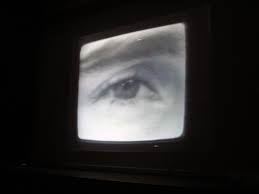
Eyebath, by Peter Anderson (1977): I had seen this before but it’s good to have a reminder of how simple video can be really effective and also that it’s not necessary to plaster words over everything or over-explain it, for it to be finished. It’s a video of an eye blinking but then the surface of the image is broken and ripples move across the image. You realise that it is in fact a reflection of an eye in water. To me it really evokes the sensation of having fluid dropped in your eye which as a glasses/ former contact lens wearer I am quite familiar with!
In the Home by Ian Breakwell (1980): this is a video I had not seen before and concerns a couple in a domestic setting talking to each other but their statements slightly missing each other or not quite making sense. They slip between love/hate, dominance/submission and possibly different time frames. It reminded me of Bruce Nauman’s work Violent Incident which is exhibited as a bank a bank of screens where a couple interact around a dinner table, having a meal but then ending up arguing and with some slap-stick like activities, including stabbing each other with a fork. The scenario on each screen plays out a slightly different way. In Breakwell’s video, the middle section of the video is the most abstract part of the video and I found this most interesting. The image on screen is the couple’s legs in bed under a blanket. Over this we hear a soundtrack of phrases that suggest (along with the image) possible sexual activity and power dynamics. What struck me about it was the collaging and overlaying of phrases in a semi-abstract way and the urge to search for meaning within this. It also reminded me of Samuel Beckett’s play ‘Not I‘ (well, at least the ‘Becket on Film‘ version of it that I have seen).